
A newly appointed director arrives with energy and a clear sense of what needs fixing. By week three, they have announced a restructure, changed the weekly reporting and cancelled a project the team had been working on for months. Each decision might even be right. But the team has already drawn its conclusion: this person decides before they listen.
That pattern is one of the most common ways capable people damage their first year in a senior role, and it rarely shows up in their performance review until much later. The first 90 days at director level are less about what you deliver and more about the trust, understanding and direction you build. Get those right and delivery follows. Get them wrong and every later decision is harder than it needs to be.
This guide sets out what people are watching for in your first three months, what to hold back on, and a practical plan for each phase.
Why the first 90 days matter more at director level
At manager level, people mostly judge you on whether things get done. At director level, a much wider group is forming a view of you, and they form it quickly. Most of what they conclude in the first few weeks comes from how you behave rather than what you achieve.
| Who is watching | What they are looking for | What they conclude if it goes wrong |
|---|---|---|
| Your direct reports | Whether you listen, whether you’re fair, whether their work is understood | “They’ve already made up their mind about us.” |
| Your peers | Whether you’ll be a partner or a competitor for resources | “They’re building an empire.” |
| Your boss | Whether you can be trusted with ambiguity, and how quickly you get to grips with things | “We may have hired the wrong person.” |
| People two levels down | Whether anything will change for them, and whether you know they exist | “Nothing changes, whoever is in charge.” |
None of these judgements are final, but early impressions are expensive to reverse. It is far easier to build trust in the first month than to rebuild it in the sixth.
What to hold back on
The instinct of a capable new leader is to show value quickly. That instinct is useful, but in the first month it needs restraint. These are the moves I’d encourage most new directors to delay:
- Restructuring. Structure changes are hard to undo and signal that you have already decided what’s wrong. Wait until you understand why things are the way they are.
- Judging people on first impressions. The most visible people in the first weeks are not always the most capable. Some of your strongest people will be quiet until they trust you.
- Bringing in “how we did it at my last organisation.” Once or twice is useful context. More than that and people hear that their work doesn’t count.
- Cancelling work in progress. Unless something is clearly failing, find out who championed it and why before you stop it.
- Committing to targets you don’t yet understand. Agree to come back with a view by a set date instead.
Holding back is different from doing nothing. You are gathering the understanding that makes your later decisions faster and better received.
A three-phase plan
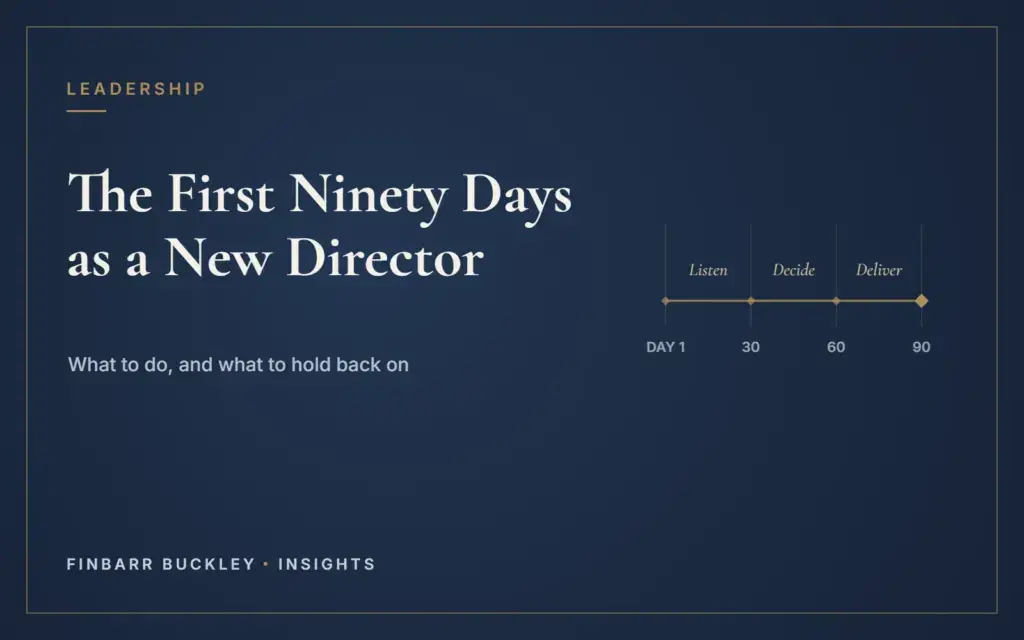
Most new directors find it helpful to think of the first 90 days in three phases. The boundaries are approximate; what matters is the order.
| Phase | Focus | What you’re doing | You’re ready to move on when… |
|---|---|---|---|
| Days 1–30 | Listen and learn | One-to-ones with every direct report, key peers and stakeholders; reading the numbers; understanding history and politics | You can explain the three or four biggest issues in the organisation’s own language |
| Days 31–60 | Decide and align | Testing your emerging view with your boss and team; agreeing priorities; identifying one or two early wins | Your boss and leadership team broadly agree with your diagnosis |
| Days 61–90 | Set direction and deliver | Sharing a clear direction for the next year; making the first structural or people decisions; delivering early wins | People can describe where the function is going and why |
Days 1–30: listen and learn
Your main job is to understand the organisation as it actually works, not as the job description describes it. Meet everyone who matters, and meet them properly: an hour, not fifteen minutes. Read the last year’s board or leadership papers. Find out what was tried before and why it didn’t work.
These questions open up most listening conversations:
- What’s working well that I should be careful not to break?
- What’s getting in the way of you doing your best work?
- If you were in my role, what would you focus on first?
- What has been tried before, and what happened?
- Who else should I be talking to?
- What do you need from me?
Keep notes and look for patterns. When three different people describe the same problem in different words, you have found something real.
Days 31–60: decide and align
By now you will have a view. Before you act on it, test it. Share your diagnosis with your boss and ask what you are missing. Share it with your leadership team and ask what they would change. You are looking for agreement on the problems before you push for agreement on the solutions.
This is also the point to choose one or two early wins. A good early win is visible, achievable within a few weeks, and fixes something people have been frustrated by for a long time. It shows that you listened as well as that you can deliver.
Days 61–90: set direction and deliver
Now you can move. Set out a clear direction for the next 12 to 18 months: what the function will focus on, what it will stop doing, and how success will be measured. Make the structural and people decisions you held back on earlier, and explain the reasoning behind them. Because you listened first, people are much more likely to accept decisions they don’t like.
Who to meet in the first two weeks
- Your boss, to agree expectations, priorities and how they want to work with you.
- Each direct report, individually, before you meet them as a group.
- Your key peers, especially those whose work depends on yours.
- People two levels down, in small groups. They often see problems most clearly.
- Important customers, partners or stakeholders outside your function.
- Anyone who applied for your role. This conversation is uncomfortable, and that is exactly why it needs to happen early.
Agreeing expectations with your boss
Many difficult first years can be traced back to one missing conversation in the first fortnight. Your boss has a picture of what they hired you to do, and it is rarely written down in full. Find out what it is before you build your plan around something else.
| Topic | Question to ask | Why it matters |
|---|---|---|
| Priorities | “If I only got two things right this year, what should they be?” | Stops you spreading effort across everything the job description lists |
| Decision rights | “Which decisions do you want to be involved in, and which are mine?” | Avoids surprises in both directions |
| Communication | “How and how often would you like to hear from me?” | Some bosses want a weekly note; others only want to hear about problems |
| History | “What do I need to know about why this role was vacant?” | Explains reactions you would otherwise misread |
| Early signals | “What would make you confident, at six months, that this was the right appointment?” | Turns a vague expectation into something you can work towards |
| Constraints | “What’s off the table, at least for now?” | Budget, headcount or politics you can’t see yet |
Write up what you agreed in a short note afterwards and ask them to correct anything you’ve misunderstood. It takes ten minutes and can save months of crossed wires.
Reading the team you’ve inherited
One of the hardest parts of a new senior role is forming a fair view of the people you’ve inherited. You will hear opinions about them from the moment you arrive, from your predecessor, your boss, HR and colleagues. Some will be accurate. Some will be several years out of date, or shaped by a relationship you know nothing about.
A few principles help you see people more clearly:
- Separate performance from circumstance. Someone struggling under a previous manager may do well under different leadership, and the reverse is also true.
- Look at their work, not just their presence. The most confident person in meetings is not always the one whose work you’d rely on.
- Ask what they would change. People who have thought about how their area could work better usually have more to give.
- Give everyone a clean start, but not an indefinite one. Form a provisional view by around day 60, test it, and act on it in the third month if you need to.
| What you notice | What it might mean | What to check before concluding |
|---|---|---|
| Quiet in team meetings | Disengaged, or thoughtful and waiting to trust you | How they contribute one-to-one, and what their work shows |
| Defensive about their area | Protecting poor results, or protecting good work that has been criticised before | The history behind their area and its results |
| Asks you for decisions constantly | Lacks confidence, or was managed that way by your predecessor | What happens when you hand the decision back |
| Very keen to impress you | Ambitious and capable, or managing upwards | How their own team describes working for them |
If you’ve been promoted from within
Much of this guide assumes you are new to the organisation. If you have been promoted internally, the same principles apply, with two differences. You already know a great deal, so the risk is assuming you know everything. And the people around you already know you, so the challenge is showing them that something has changed.
- Still hold the listening conversations. People will tell their new director things they never told a colleague.
- Look at familiar problems from the level of the new role. Issues that seemed fixed from below often look different with full responsibility.
- Be especially careful about fairness to former peers. Even small signs of favouritism are noticed quickly.
If you’re now leading people who used to be your colleagues, Leading Former Peers: How to Make the Transition Without Losing Trust covers that transition in detail.
Common mistakes
- Proving yourself through speed. Fast decisions in month one are remembered long after the reasoning behind them is forgotten.
- Spending all your time with your direct reports. Peers and stakeholders shape how your function is seen across the organisation.
- Leaving your boss to guess. Agree how and how often you will update them, and stick to it.
- Treating the 90 days as a probation. They are the foundation for the next two years, not a test to pass.
- Forgetting yourself. A new senior role is demanding. Protect your energy and your judgement, especially in the first month.
Your 90-day plan
Use this to plan your own first three months. The first row shows how one phase might look.
| Phase | What I need to learn or decide | Who I need to see | What I will deliver |
|---|---|---|---|
| Days 1–30 | Why customer complaints doubled last year; how decisions are really made | All eight direct reports, finance director, two key clients | A written summary of what I’ve heard, shared with my boss |
| Days 31–60 | |||
| Days 61–90 |
If you’re still at the interview stage, Director-Level Interview Questions: What the Panel Is Really Assessing explains how to talk about your first 90 days in a way panels trust.
Not sure where your strengths and gaps sit as a leader? The free Leadership Readiness Assessment takes about ten minutes.
Starting a new senior role?
I work one-to-one, online, with senior leaders stepping into bigger roles. Wherever you’re based, sessions are scheduled around your time zone.
The Lead With Clarity Programme is a 12-week coaching programme for leaders who want to lead with more clarity, confidence and impact. It combines one-to-one sessions with guided implementation weeks, so the changes happen in your actual role between sessions. Many leaders use it to shape their first three months in a new position.
If you’ve recently stepped up, or are about to, book a discovery call and we’ll look at what your first 90 days need to achieve.