
Most senior candidates have known the STAR method for years before they sit in front of a director-level panel. Situation, task, action, result. It’s taught on graduate schemes, printed in every interview guide and recommended by almost every recruiter. So it comes as a surprise when an experienced leader uses it carefully and still gets feedback like “solid, but we didn’t get a sense of your judgement.”
The problem usually isn’t STAR itself. Panels at every level expect a structured answer, and STAR gives you one. The problem is that most people use it the way they first learned it, when the panel wanted to know whether they could get a task done. At senior level the panel is asking a different question: can we trust this person’s judgement with things that matter?
This guide explains where the textbook version falls short for senior candidates, how to rebalance it, and how to prepare a small set of stories that will cover most of what a panel asks.
Why the textbook STAR method falls flat at senior level
When I listen to senior candidates rehearse, the same few problems come up again and again.
| What happens | Why it costs marks |
|---|---|
| The situation takes half the answer | Long background uses up the time the panel needs for your decisions. By the time you reach the action, attention has drifted. |
| “We” throughout | The panel is assessing you, not your team. If they can’t tell which decisions were yours, they can’t score them. |
| The action is a list of tasks | “I set up a working group, ran workshops and produced a plan” describes activity. It doesn’t show the judgement behind it. |
| The result stops at the project | “We delivered on time” is a middle-management result. Senior panels want to hear what changed for the organisation. |
| No reflection | Panels assessing potential listen for what you learned. Without it, an answer can sound rehearsed, or as if nothing could have gone better. |
None of this means the candidate lacks senior experience. It means the structure is hiding it.
The senior version: keep the letters, change the weighting
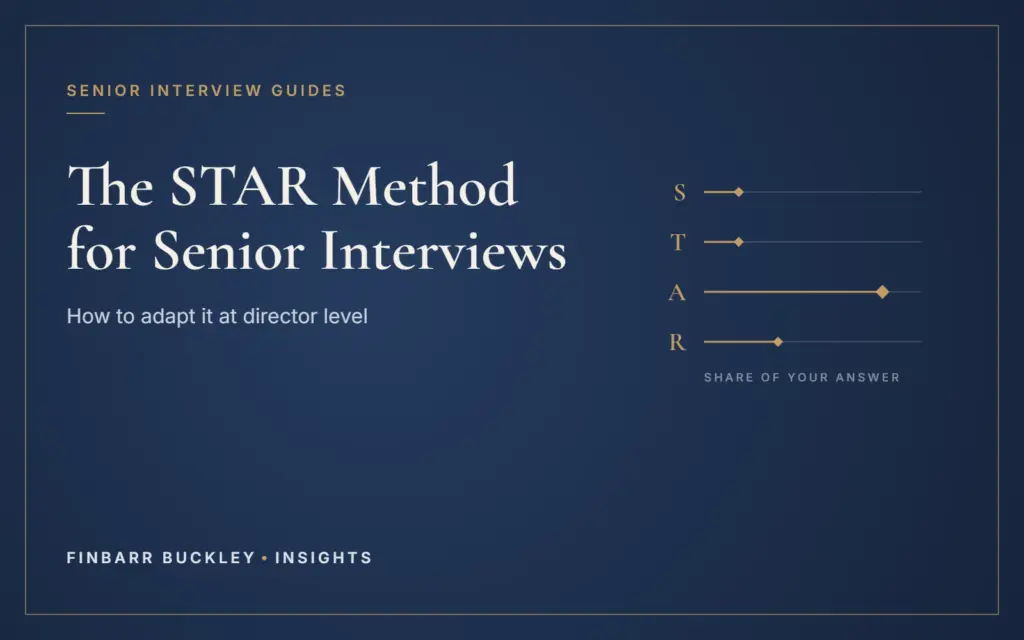
You don’t need a new acronym. Keep STAR, because panels recognise it and it keeps you organised under pressure. What changes is how much time each part gets, what goes into it, and one short addition at the end. For a two-to-three-minute answer, roughly:
| Part | Time | What to cover at senior level |
|---|---|---|
| Situation | 15–20 seconds | The organisation, your role and what was at stake. One or two sentences. Leave out the history. |
| Task | 15–20 seconds | What you were accountable for, and why it fell to you. Not what the team was asked to do. |
| Action | About 90 seconds | Your thinking first: the options, the risks and why you chose your approach. Then what you personally did, including how you brought people with you. |
| Result | 20–30 seconds | The outcome in numbers where you have them, then the wider impact on the organisation, its customers or the public. |
| Reflection | 10–15 seconds | What you’d keep and what you’d do differently. One honest sentence is enough. |
Action gets most of the time because that is where a panel sees your judgement. Here is what each part needs at this level.
Situation: set the stakes, not the scene
The panel doesn’t need the backstory. They need enough to understand why this example matters. A useful test: after your first two sentences, could a non-specialist on the panel explain what was at stake? Scale helps. “A €40 million programme across four regions” tells the panel more than a minute of background.
Task: name your accountability
Many candidates describe the team’s objective here. Make it personal instead: what were you responsible for, and what would have happened if you’d got it wrong? Phrases like “I was accountable for…” or “The decision was mine because…” make the panel’s job easy.
Action: show the thinking before the doing
This is where senior answers are won or lost. Before describing what you did, give the panel a short window into how you decided: the realistic options, the main risk, and why you chose the route you did. Then describe your actions in order, using “I” for your decisions and crediting the team for their work.
At senior level, good actions are usually about people as much as plans. Who did you need to persuade? Where did you meet resistance, and how did you deal with it? What did you delegate, and why? Those details show the panel how you lead, not only what you delivered.
Result: go beyond the project
Give the measurable result first, then one sentence on what it meant more widely: a cost that stayed down, a capability the organisation kept, a relationship that improved. If the outcome was mixed, say so. A candid account of a partial success is more convincing than a story where everything went to plan.
Reflection: one sentence, honestly
Close with what you learned or would change. Keep it short and genuine. “If I did it again, I’d bring finance in a month earlier” shows self-awareness. A long confession undermines the answer you’ve just given.
Before and after: one example, two ways
Here is an illustrative answer to “Tell me about a time you made a difficult decision with incomplete information.” It is a composite example, not a real client.
The textbook version
“At the time I was head of operations at a logistics company. We’d had a difficult couple of years, there had been a restructure, and the leadership team had changed twice. We were reviewing our warehouse network and there were a lot of different views about what to do. We set up a working group, did a lot of analysis, consulted the regional teams and eventually decided to close one of the sites. It was a tough process, but we got there and the closure went smoothly.”
It follows the STAR order, but the panel learns almost nothing about the candidate’s judgement. There are no stakes, no options, no individual decision and no result they can score.
The senior version
“As head of operations, I had to recommend whether to close one of our three distribution centres, with demand forecasts that could have gone either way. Getting it wrong meant either €3 million a year in surplus capacity or letting down our largest customer at peak. The recommendation was mine to take to the executive team.
I looked at three options: close now, wait six months for better data, or close in phases. Waiting looked safe, but it would have cost us the lease break. I chose a phased closure, with a clear trigger for pausing if volumes rose. I took the plan to the regional managers myself before it went to the executive team, because their support would decide whether it worked, and I agreed with finance exactly which figures would trigger the pause.
We completed the closure in seven months, saved €2.6 million in the first year and didn’t miss a delivery commitment at peak. Looking back, I’d have involved the union representatives earlier. We got there, but it would have saved us a difficult month.”
The story is the same and the answer is not much longer. This time the panel hears the stakes, the options, the decision and the reasoning behind it, how the candidate brought people with them, and a result they can mark.
Questions where STAR isn’t the right tool
STAR is built for “Tell me about a time…” questions. Some senior questions need a different shape.
- Motivation and strengths (“Why this role?”, “What do you do best?”). Give a direct answer, one example that proves it, and a link to what the role needs.
- Hypothetical and situational questions (“What would you do if…?”). Explain how you’d assess the situation, the options you’d weigh, what you’d do first and how you’d know it was working. A short past example can show you’ve handled something similar.
- Strategy and vision questions (“Where would you take this function?”). Give your view first, then your reasoning and priorities. Forcing a STAR story onto these can sound evasive.
For the full range of questions senior panels use, see Director-Level Interview Questions: What the Panel Is Really Assessing.
Building a story bank that covers most questions
You don’t need a separate story for every possible question. Most senior candidates can cover the majority of competency questions with six to eight well-prepared examples, as long as each one is rich enough to be told from different angles.
- Choose stories with range. Aim for a mix: leading change, a difficult people decision, a commercial or financial result, influencing senior stakeholders, a setback, and a partnership across organisational boundaries.
- Keep them recent and at the right level. Examples from the last few years, at or close to the level of the role, carry the most weight.
- Write each one as bullet points under the five headings, not as a script. Scripts sound rehearsed and fall apart when the panel interrupts.
- Note the angles each story can serve. A restructure might answer questions on change, difficult conversations and stakeholder management, with a different emphasis each time.
- Know your numbers. Budgets, headcount, timescales and results for every story, so you’re never estimating under pressure.
- Rehearse out loud, with interruptions. Ask someone to stop you with “What did you do specifically?” and “What would you do differently?”
A simple story bank. Keep each entry to a few words per column:
| Story | Stakes | Your decision | Result | Questions it can answer |
|---|---|---|---|---|
| Phased distribution centre closure | €3m a year at risk; uncertain demand | Phased closure with a trigger to pause | €2.6m saved in year one; no missed deliveries | Judgement, leading change, influencing stakeholders |
For how competency panels mark each answer, see Competency-Based Interviews: A Guide for Senior Candidates. For why flexible evidence beats memorised answers, see Senior Interviews: Prepare Evidence, Not Answers.
Common mistakes
| Mistake | What to do instead |
|---|---|
| Spending a minute on background | Two sentences on the stakes, then move on. |
| Saying “we” for every decision | Use “I” for your decisions and credit the team for theirs. |
| Listing activities | Explain the options and why you chose your approach. |
| Stopping at “it was delivered” | Give the number, then the wider impact. |
| Polishing out every difficulty | Name the setback and how you handled it. |
| Using the same story for every question | Prepare six to eight stories and vary them. |
| Running past three minutes | Stop after the reflection and let the panel probe. |
Structure that shows judgement
Used well, STAR keeps your answers clear when you’re under pressure. Used mechanically, it turns real senior experience into something that sounds like a project report. The aim is simple: make your judgement easy to see, and easy to score.
For a worked example of one of the hardest senior questions, see How to Answer “Tell Me About a Time You Led Change” at Senior Level.
Preparing for a senior interview?
I work one-to-one, online, with senior professionals preparing for director, head-of and executive interviews. Wherever you’re based, sessions are scheduled around your time zone.
In the Interview Preparation Programme, we build your story bank together, rework your answers so your judgement comes through, and practise in realistic mock panels with the follow-up questions you’re likely to face.
If you have an interview coming up, book a discovery call and we’ll look at which of your stories will carry the most weight.