
Strong performance gets you considered for promotion. It rarely gets you chosen.
That gap catches a lot of capable professionals off guard. They hit their targets, solve problems nobody else wants to touch, and get good reviews. Then the role goes to someone else, and the feedback is vague: “not quite ready”, “we’d like to see more leadership”, “keep doing what you’re doing”.
Here is what is usually going on.
The decision is made about the next role, not the current one
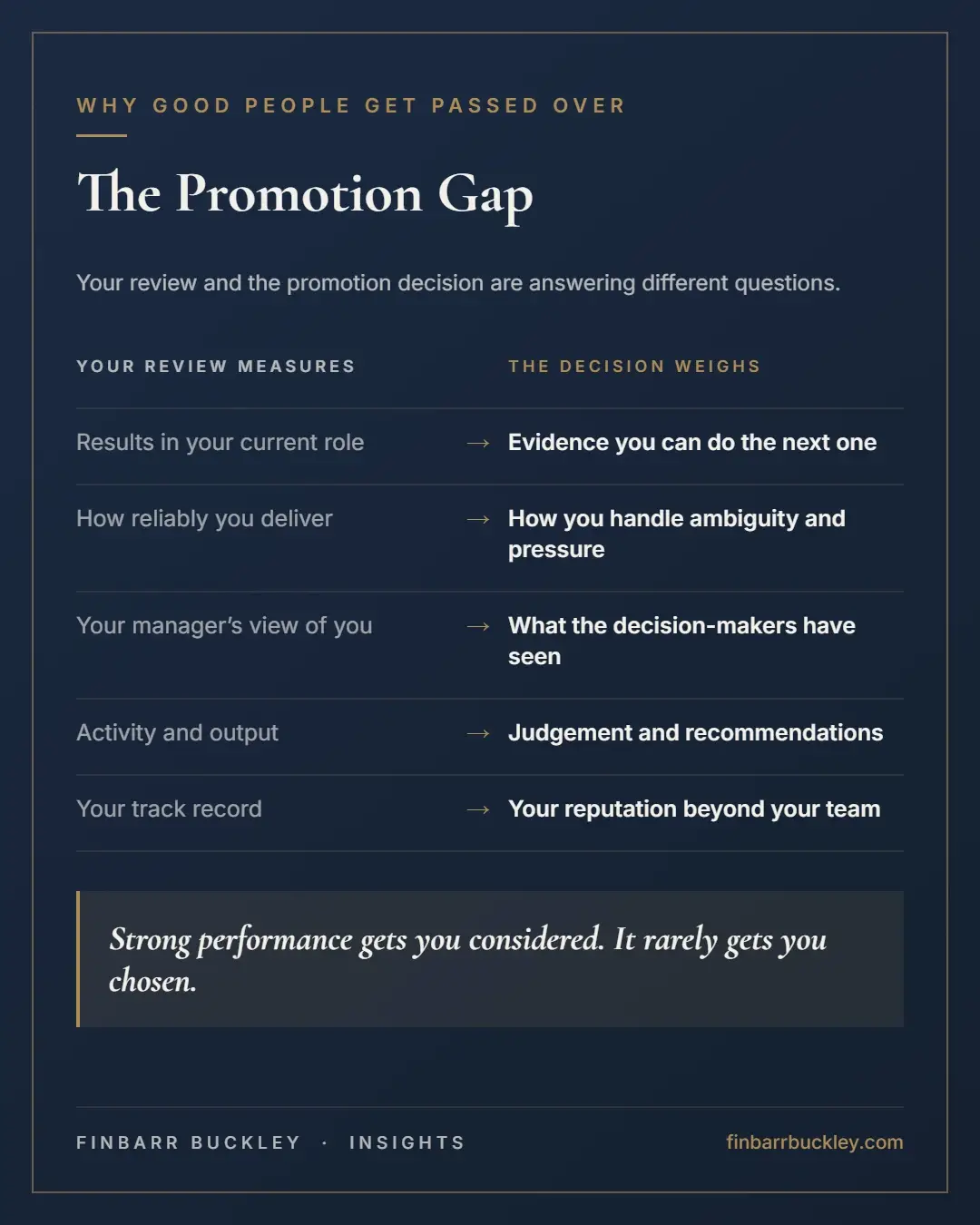
Your performance review measures how well you do the job you have. A promotion decision is a bet on how you will do a job you have not done yet. Those are different questions, and the people answering the second one are looking for different evidence.
If everything people see from you is excellent delivery, you have made a very strong case for keeping you exactly where you are.
The people deciding often see less of your work than you think
Your manager knows what you do. Their manager, the panel, the peers who get asked for an opinion in the hallway, often do not. They form a view from a handful of moments: how you handled a difficult meeting, what you said when a plan went wrong, whether you brought a problem or a recommendation.
That view becomes your reputation, and reputation travels further than results.
What to do differently
None of this means becoming a self-promoter. It means being deliberate about the evidence you create.
- Find out who actually decides. Not the org chart version. Who is in the room, and whose opinion do they ask?
- Ask what “ready” looks like. Get specific. “More strategic” is not feedback until someone tells you what they would see you doing.
- Work one level up, visibly. Take a problem that belongs to the next role and own it in a way the decision-makers will notice.
- Change how you report. Swap updates on activity for a view on what it means and what should happen next.
The shift is small on paper. In practice it changes how people talk about you when you are not there, which is where promotion decisions are really made. If the next step involves a formal interview, these director interview questions show what a senior panel will be listening for.
If this sounds familiar and you want a clear plan for your next step, book a discovery call.