
Most interview preparation starts with a list of likely questions and a set of rehearsed answers. At junior level, that works reasonably well. At senior level, it often backfires.
Here is the pattern I see more than any other in mock interviews. A senior candidate gives a fluent, well-structured answer. The panel nods. Then comes the first follow-up: “What did you do when the finance director disagreed?” The answer gets vaguer. By the second follow-up, the candidate is improvising, and the panel has learned more from those thirty seconds than from the three polished minutes before them.
Experienced panels have heard every polished answer. What they are listening for is whether there is real substance underneath, and they will keep asking until they find out. This guide explains why rehearsed answers fail at senior level, what to prepare instead, and how to build an evidence bank that holds up under any version of the question.
Why rehearsed answers fail at senior level
A rehearsed answer is built for the question you expect. Senior panels rarely ask the question you expect, and they almost never stop at the first answer. Three things work against a script:
- Panels probe. At director and executive level, the follow-up questions carry more weight than the opening question. A script covers the opening and leaves you exposed for everything after it.
- Questions arrive in unfamiliar wording. “Tell me about a time you led change” might come as “What’s the hardest transformation you’ve been part of?” A memorised answer struggles to bend to a new frame.
- Scripts sound like scripts. Senior panels are assessing judgement and presence as much as content. An answer delivered from memory sounds rehearsed, and rehearsed reads as guarded.
Evidence works differently. If you know a piece of work thoroughly — the decision, the people, the trade-offs, the numbers — you can answer any question about it, in any order, at any depth the panel wants.
What senior panels are really probing for
Most follow-up questions fall into a small number of types. Each one is testing something specific, and each one needs a different kind of evidence ready:
| The follow-up | What it’s testing | Evidence you need ready |
|---|---|---|
| “What exactly did you do?” | Your personal contribution, separate from the team’s | The decisions that were yours, and the ones you delegated |
| “What else did you consider?” | Judgement and strategic thinking | The options you rejected, and why |
| “Who disagreed?” | Influence and stakeholder management | Who pushed back, their concern, and how you responded |
| “How do you know it worked?” | Commercial and outcome focus | Results with numbers, and how you measured them |
| “What would you do differently?” | Self-awareness and learning | An honest misjudgement and what changed afterwards |
| “How would that apply here?” | Transferability to this role | The principle behind what you did, not just the event |
If you can answer all six about a piece of work, it is evidence. If you can only answer the first, it is an anecdote.
Build an evidence bank, not a script
Instead of scripting answers, prepare eight to ten strong examples from your recent work that you can adapt to almost any question. For each one, be clear on:
- The situation and why it mattered to the organisation, not just to you.
- The decision you made, and the alternatives you rejected.
- Who you had to bring with you, and who pushed back.
- The result, with numbers where you have them.
- What you would do differently now.
Once you have your examples, shape each into a spoken answer with the rebalanced structure in The STAR Method for Senior Interviews: How to Adapt It at Director Level.
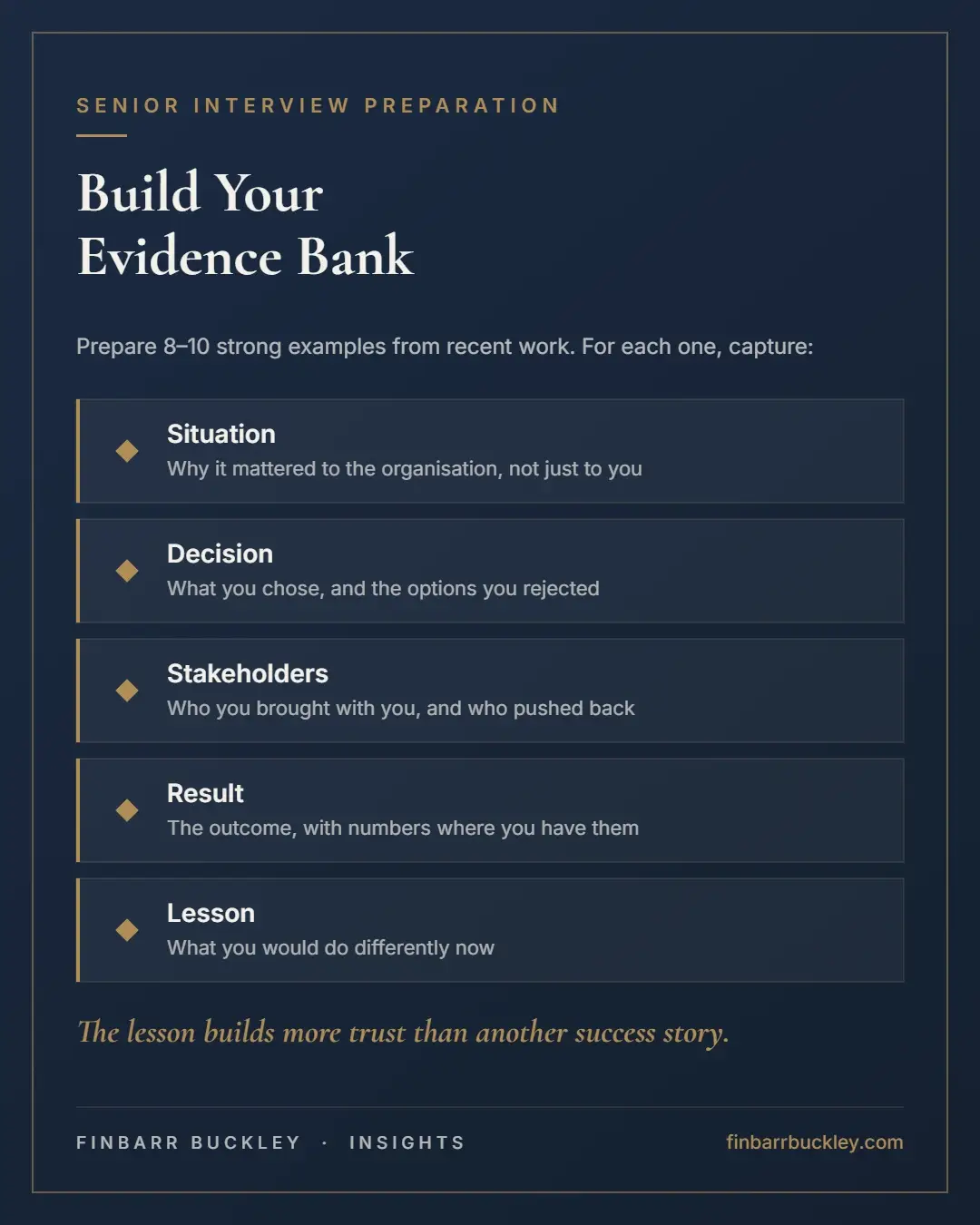
That last point matters more than people expect. Senior panels are wary of candidates who have never got anything wrong. A clear, unforced account of a misjudgement and what you learned from it builds more trust than another success story.
Choosing which examples to include
Eight to ten examples is enough to cover almost any senior interview, provided they are spread well. Before you prepare any of them in depth, check that between them they cover these areas:
| Area to cover | What a strong example shows |
|---|---|
| Strategy and priorities | A choice about direction, including what you stopped doing |
| Leading leaders | Someone you developed, or a leadership team you built or reshaped |
| Change | Bringing people through a significant shift, including resistance |
| Influence | Moving peers, executives or partners you had no authority over |
| Commercial ownership | A budget, cost or value decision, with figures |
| Difficult decisions | A call that was unpopular or made with incomplete information |
| Setback | Something that went wrong, and what you changed as a result |
Favour recent work, ideally from the last three years, and work at or close to the level of the role. A brilliant story from ten years ago tells the panel more about who you were than who you are.
Talk at the level of the role
The second common gap is altitude. Candidates describe what they did in detail, and the panel is left wondering whether they understand why it mattered. For a senior role, lead with the business problem and the outcome, then go into the detail only as far as the panel wants.
A simple test: if your answer would make sense coming from someone two levels below the role, it is pitched too low.
In practice, that means opening each example with one sentence on what was at stake for the organisation, and one on the decision you made. The panel can then choose where to dig. You stay in control of the story because you know every layer beneath it.
Practise out loud, under pressure
Reading your notes is not practice. Say your examples out loud, to someone who will interrupt you and ask the awkward follow-up. That is where you find out which stories hold up.
- Tell each example in two minutes. Time it. Most people run long the first time.
- Then tell it in thirty seconds. If you can’t, you haven’t yet found the point of the story.
- Ask someone to probe with the six follow-ups above. Note every question where your answer became vague.
- Fill the gaps from the facts, not from imagination. Check old reports, emails and figures. Invented detail is the first thing a good panel finds.
- Answer a question you didn’t prepare for using one of your examples. This is the real test of whether you have evidence or a script.
Common mistakes
- Preparing twenty answers instead of eight examples. Breadth of scripts gives you nothing to fall back on when the question changes.
- Choosing examples for drama rather than relevance. The crisis story is memorable, but it may not show the competencies this role needs.
- Hiding the people side. Leaving out disagreement and resistance makes the work look easier than it was, and makes your role look smaller.
- Rounding away the numbers. “Significant savings” invites the question “How much?” Have the figure ready.
- Only bringing successes. Without a genuine setback in your bank, the “What would you do differently?” question has nowhere to go.
Build your evidence bank
Use this table to prepare each example. The first row shows how one might look; fill the rest from your own work.
| Example | What was at stake | Your decision | Result, with numbers |
|---|---|---|---|
| Restructuring a regional team | Rising attrition and missed targets across two sites | Replaced two management layers with three team leads | Attrition down from 22% to 9% in a year; two leads later promoted |
Then match each example against the questions you are likely to face. Director-Level Interview Questions: What the Panel Is Really Assessing sets out the questions senior panels use most, and How to Answer “Tell Me About a Time You Led Change” shows how to shape one example under heavy probing. If you are facing a scored, framework-based interview, Competency-Based Interviews: A Guide for Senior Candidates explains how to map your evidence to the indicators.
Not sure whether you’re ready for the step up? The free Leadership Readiness Assessment takes about ten minutes and shows where your strengths and gaps sit.
Preparing for a senior interview?
I work one-to-one, online, with senior professionals preparing for director, head-of and executive interviews. Wherever you’re based, sessions are scheduled around your time zone.
The Interview Preparation Programme covers role-specific strategy, answer development, mock panel interviews with realistic follow-up questions, and coaching on communication and presence. We build your evidence bank together and test it until it holds up under any version of the question.
If you have an interview coming up, book a discovery call and we’ll look at what the panel will be testing for.